
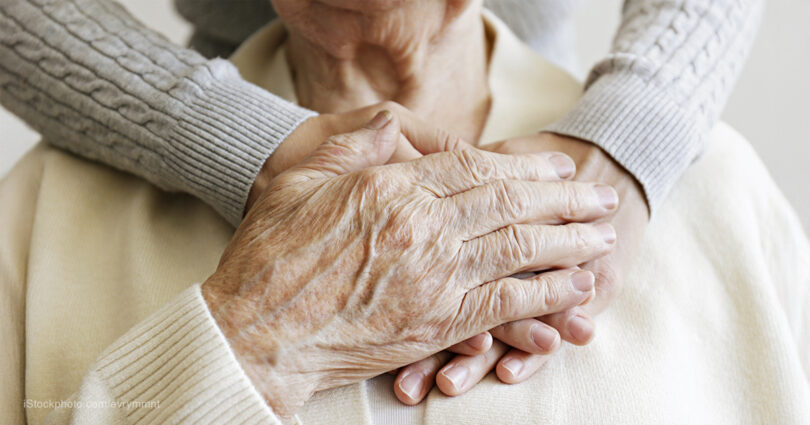
The elderly are immense gifts to society, yet too often today we see that our culture focuses on personal fulfillment, which can then lead to the neglect of people who are no longer deemed necessary or productive. This includes the sick and the elderly, who may feel lonely, abandoned, and isolated from their own families. While working in residences for the elderly, I often saw the loneliness of those left to themselves, and it reminded me of my mother and the time I spent ministering to her needs. I thank God that I was able to care for her and that she was not alone.
Caring for my mother
My mom raised me by herself after my father left us. She instilled in me a sense of sacrificial love, in imitation of Christ’s love for mankind. She believed in the teachings of the Catholic Church and adhered to its precepts, including those regarding the inherent dignity of each person, made in the image of God, from the moment of creation to the moment of natural death. This would never be more evident than in the hardships she endured in her final years.
My mother was in very bad health for the last decade of her life; she suffered from diabetes, kidney failure, cardiovascular disease, retinopathy, neuropathy, and cancer that eventually spread throughout her body. She lived with constant pain, yet she never lost hope in God. She even kept her sense of humor, often making me laugh despite what was happening to her body.
During those 10 years of physical hardship, I became my mother’s primary caregiver. I put my life on hold to care for the woman who had sacrificed so much during her lifetime to care for me. Three days before she died in my arms, my mom spoke her last words to me, telling me how much she loved me. She smiled and found the strength to stroke my hair. She was so beautiful and looked like an angel. I sang her favorite hymns while cradling her in my arms. I will hold these memories in my heart for the rest of my life.
Love, not euthanasia, is the answer to suffering
Years of taking my mom to appointments with various doctors, sitting with her daily while she lay in the hospital room, administering her medications, going through treatments, and staying up nights to tend to her needs have all strengthened my convictions that the sick and the elderly need loving care. We must never abandon them or make them feel like burdens. And, most importantly, we must offer spiritual care. Belief in God, hope in His promises, and prayer go a long way in managing the depression and feelings of despair that can accompany physical suffering.
Sadly, in our throwaway culture, many sick and elderly persons never receive this care. Instead, they are abandoned, causing further spiritual, mental, and physical suffering. Feeling unwanted and depressed can deplete their motivation and their strength to take good care of themselves, thus affecting their overall health and willingness to live. Indeed, the CDC shares that loneliness and isolation can increase the risk of anxiety, depression, dementia, diabetes, heart disease, self-harm, stroke, and suicidality.
Rather than responding to this pain with loving care, today’s culture pushes euthanasia and assisted death as the answer to suffering. The incessant narrative of “dying with dignity” and “choosing your death” hides the reality that feeling unwanted and burdensome are often the real reasons people choose assisted suicide.
This rising trend can be seen throughout the world, as people are opting to end their lives in record numbers. In 2024, medical assistance in dying was responsible for 16,499 deaths in Canada, a 6.9% increase from 2023. Assisted death, which is only legal in 13 US states and the District of Columbia, has been responsible for the deaths of more than 14,400 Americans since 1997 and has grown nearly 1,000% in the last decade. European countries are also seeing a rise in assisted suicide. For example, suicide rates among those aged 85 and older in Switzerland have quadrupled in the past 25 years and doubled among those aged 65 to 84.
Care is crucial to a culture of life
I can’t help but think that the seeming loss of belief, hope, and trust in God over the years, in a secularized society such as ours in North America and Europe, has inexorably led to this worldly concept of ending life on one’s own terms and minimizing the importance of family bonds.
If we want to counter this scourge of loneliness and the desire for an early death, we must offer hope through the accompaniment of family members and the community, specifically religious organizations and pastoral volunteers. Put yourself in the shoes of an elderly or sick person and take action to love them. Volunteer to sit with an elderly friend or neighbor, or even a stranger in a nursing home, for just one or two hours a week. Show them they are loved and needed, not a burden to be gotten rid of and hastened to their death.
This care has the two-fold benefit of giving hope to the downtrodden and fulfilling one of the Corporal Works of Mercy as prescribed by the Church. After all, human beings are made of both body and soul, and the soul needs nourishment as well as the body.
I thank God that I was able to accompany my mother in her final years. I hope that my story inspires others to lovingly care for the elderly so they do not succumb to despair. Every moment lived is a chance to share memories with loved ones. If my mother had opted for euthanasia, I would not have grown in my own faith and compassion for others, and I would not have these unforgettable memories of her inner beauty and faith in God. The truth is that, while I was helping her physically and emotionally, she was helping me spiritually, through her example of faith-filled perseverance and fortitude.
Every single moment of life is precious. Let us accompany the sick and the elderly with love, compassion, and hope, for in so doing, we counter what St. John Paul II termed the “culture of death” and acknowledge the dignity inherent in all.

Facebook Comments