
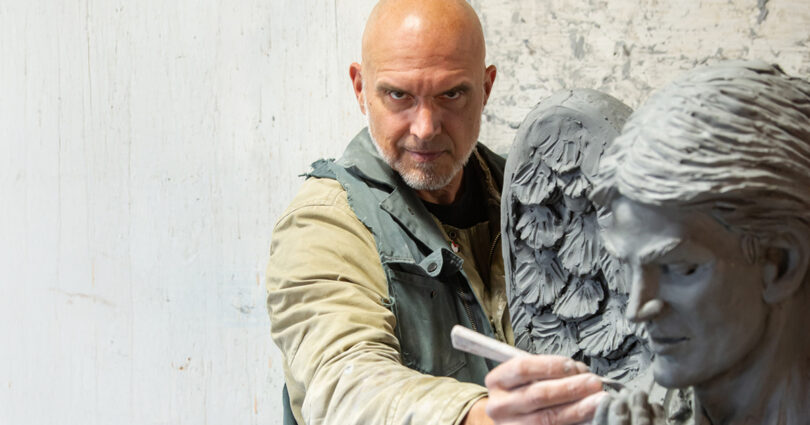
A vision inspired by God and by faith and then lovingly fashioned into reality by the hands of man. That is the gift that Canadian sculptor Timothy Schmalz gives to the world. His bronze religious sculptures have found homes in thousands of locations around the globe, even in St. Peter’s Square, and are meant to both inspire and bring the observer closer to God. As Schmalz explained to Celebrate Life Magazine, “I have faith that [artwork] can change culture.”
And through images so lovingly and expertly crafted, Timothy Schmalz is changing the culture, one sculpture and one person at a time.
Finding his calling
Timothy Schmalz fell in love with sculpting when he was 16 and even won a national competition during high school. That paved the way for his acceptance at a world-class university for the arts.
But once enrolled, Schmalz found almost immediately that he didn’t agree with the beliefs that the school espoused. He explained to Celebrate Life Magazine that the classes and methods left him uninspired and even disappointed, as the curricula included mostly abstract, conceptual artwork that he saw little point in creating. He said the mindset at the university was that if it’s not shocking, it’s not artwork.
This broke his heart, as he shared that “people are forfeiting beauty and meaning to do things that are just innovation.” More so, he felt that these creations signified “nothing” and were “anti-moral, anti-Christian, and anti-hope.”
So at 19, Schmalz had what he called an “artistic conversion” and dropped out of that university, refusing to create mainstream artwork and choosing instead to focus on what truly mattered—Christian artwork. He explained, “The perfect sculptures are in this heavenly plane, and it’s my responsibility to bring them down to earth through my hard work and discipline so they can make a change within the world.”
Today, this cradle Catholic, whose faith has grown exponentially over the years, said that his goal is “to present the eternal truths found in scripture and in the saints and bring them forth as authentically as possible.” He shared, “When I see today that our Christian culture, our Catholic culture, is oftentimes not getting that visual voice, I feel it’s my responsibility to put forth these visual ambassadors of the good, of the positive, of the messages that need to be seen today because messages do impact people.”
Now, almost 30 years later, these are the beliefs that serve as the impetus for his breathtaking sculptures.
The power of bronze
Schmalz explained that most of his sculptures are outside, so he uses bronze as a medium because it can withstand the weather and will last hundreds if not thousands of years. He also understands that outdoor sculptures can reach more people, as he has found that many individuals are “timid” about stepping inside a church but will stop to ponder a sculpture they see outside. He stated, “If I can bring the message of the Church outside, then they kind of have an inclination of what’s happening inside.”
However, creating his bronze pieces from beginning to end is not an easy task. As he explained, the process requires both dedication and time. Each bronze sculpture takes approximately six months to make. After he finds his inspiration and decides what he will create, he fashions the sculpture in clay until it matches his mind’s eye perfectly. He then makes a mold and pours bronze into it; this shapes the final sculpture.
Once he has created a mold, he can use it to make multiple editions of each sculpture, and he has done so countless times. Today, his sculptures can be found around the world, both inside and outside churches, in buildings, and even in town squares.
A visual gospel
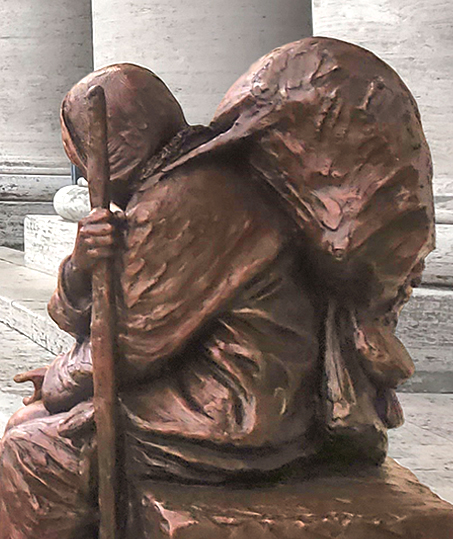
Schmalz said of his sculptures, “I like to think that you won’t even notice the texture or the style, you’ll just notice what I’m celebrating, what I’m bringing forth.”
This is beautifully illustrated in his Matthew 25 series, which depicts the Corporal Works of Mercy. One of the sculptures in this series is Homeless Jesus, which portrays Jesus as a homeless man lying on a bench, shoeless and covered with a blanket. As Schmalz’s website explains, “The Homeless Jesus brings Jesus down off the cross and into a relatable human context that allows people to feel a greater closeness with and accessibility to Christ.”
Another extraordinary sculpture, entitled Be Welcoming, is a visual reminder that we should welcome strangers. Upon first glance, the sculpture is a weary traveler sitting to the side of a bench, facing away from the onlooker. But then, as the person approaches the sculpture and sits down next to it, he sees that it has transformed into an angel. As Schmalz explains, “And then the angel welcomes you to sit down beside him.” His site shares that the sculpture “reminds us that we can become like angels on our journey through life, and also that spirituality is found only when one is generous to oneself, others, and God.”
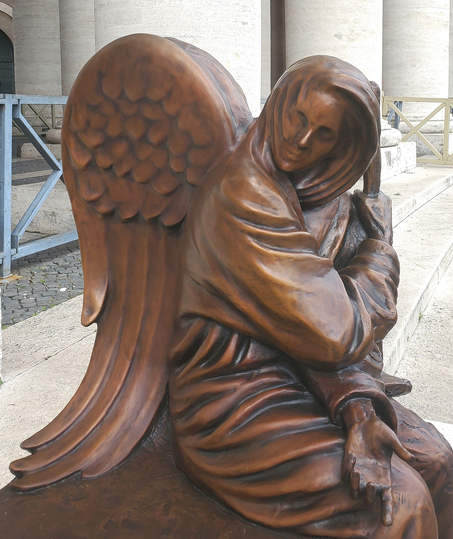
Addressing the virtue of compassion regarding refugees is the message of a sculpture entitled Angels Unawares, which stunningly contains more than 140 figures. Among other places, it can be found in St. Peter’s Square and is the first sculpture to be installed there in over four centuries. Schmalz said that the Vatican requested that he create a sculpture on the theme of immigration, and once he began to think about it, Hebrews 13:2, which says “Do not neglect hospitality, for through it some have unknowingly entertained angels,” popped into his head. As Schmalz explained, “I think that the reason why that piece is there is to show that all human life is sacred.”
The sacredness of life resonates in each of his sculptures but most poignantly in one of a mother and child.
The beauty of life
One of Schmalz’s latest and most unique sculptures is simply called Life. Showing a mother cradling her pregnant belly, this sculpture offers a literal window into the womb, as it also depicts the tiny baby inside. The sculpture is meant to represent our Blessed Mother, but to the general population it could simply be any mother.
Schmalz explained that each of his sculptures sends a message, and with this one he wanted to show the beauty of a preborn baby’s life. He shared, “Here I am giving visual light to these blind spots in our culture, and I thought there’s one other huge one, and that’s the idea of the horrors of murdering babies.”
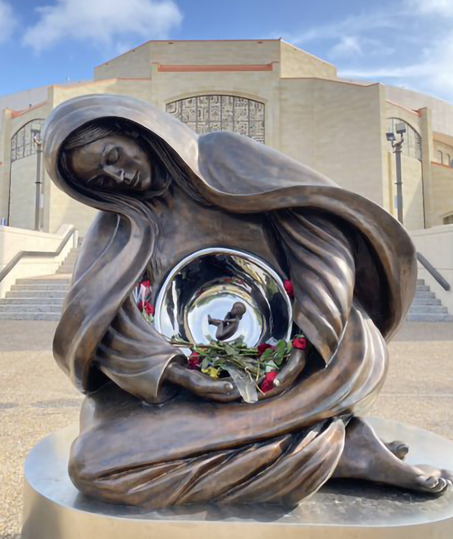
So on his own initiative in 2020, he decided to create a sculpture that would be a “visual representation of a celebration of life” and “support the idea that all life is sacred within the context of babies.”
To illustrate the tragedy of abortion, he had already created sculptures depicting an angel weeping over a crib and Jesus holding a dead preborn baby. But he said this time he felt inspired to create a work of beauty honoring life and showing a mother and child. He stated, “If I could make a sculpture that even a pro-abortion person would say, ‘That’s a nice art piece,’ then I’ll have them on my side, so to speak. . . . I wanted to do something that celebrates new life being created in the hope that the artwork would be a hand reaching out to those people who are questioning the idea of abortion or questioning the idea of the sacredness of all life.”
Schmalz is currently creating an edition of this sculpture that will sit outside the capitol building in Austin, Texas. He said it will be the “first pro-life sculpture to be installed at a state capitol.”
Life can also be found around the world, and he is excited that there will soon be one in the square in front of the Church of the Nativity in Bethlehem. This is a fitting place for it, and he explained that this “allows the message to have a phenomenal reach.”
He stated, “I don’t think we can have enough reminders that all human life is sacred. And that’s what this sculpture is all about.”
A mission cast in bronze
Schmalz puts his heart and soul into each sculpture. Subjects of past pieces include St. Carlo Acutis, the Sacred Heart of Jesus, Christ on the Cross, St. Francis of Assisi, G.K. Chesterton, and more. And he is currently working on pieces depicting Venerable Fulton Sheen, St. Bakhita, Padre Pio, the Shroud of Turin, and Mary, Queen of the Angels. As he said, “I always have company in my studio.”
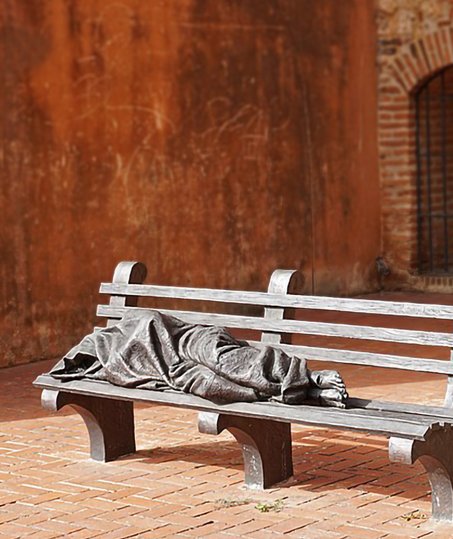
When asked about his favorites, Schmalz shared that while his favorites may change over time and he loves all his sculptures, right now he would say Homeless Jesus and Be Welcoming because “they’re so scripture oriented” and because he has heard the impact they have had on people. Life is also a favorite because it actually “has life” and shows the beauty of mothers and babies.
He explained that when he thinks of his Life sculpture he understands that as Catholics we must courageously and consistently promote the beauty of our faith, almost like a company would constantly promote its products with commercials. He said that his sculptures—these “sculptural billboards”—last forever, and they’re “like a commercial that’s going on nonstop, seven days a week, every single year.”
That continuous presence contributes to the monumental impact of each sculpture, and their enduring beauty will not only last multiple lifetimes but will hopefully provoke thought, inspire awe, and help people see the beauty of the Catholic faith. As Schmalz shared, creating religious sculptures that will move and inspire people is his “mission in life.” As someone who has seen one of his sculptures in person, I say mission accomplished.

Facebook Comments