
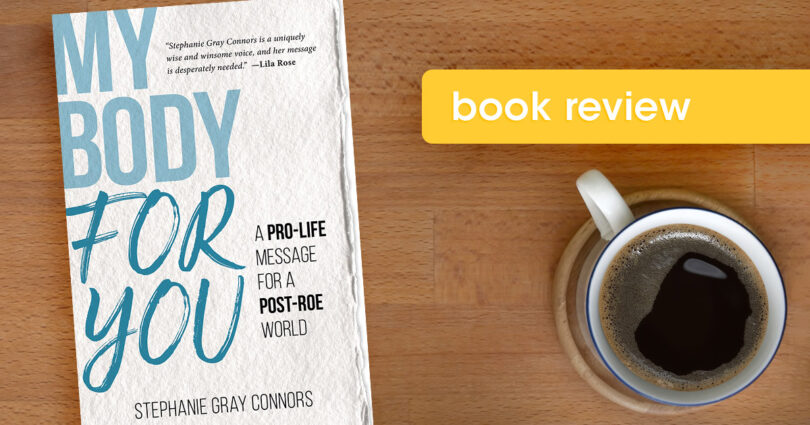
Why are we embodied beings? Are bodies just receptacles, some of which might be “wrong”? Isn’t abortion just about a woman’s body? What’s a body for?
In the light of reason and from a Catholic perspective, pro-life writer Stephanie Gray Connors (loveunleasheslife.com) asks these questions and insists the truth that bodies are not indeterminate. They are “for” something, or more accurately, for someone. They are for a communion of persons in love. Embodiment promotes interpersonal communion, not isolated individualism. Christians will also recognize the title’s Eucharistic reference: Christ’s body is given for us.
Throughout the book’s eight chapters, Connors examines the meaning of the body, offering a pro-life message for a post-Roe world. She makes a full-throated defense of life, not shying away from hard cases and misinformation used to attack Dobbs or pro-life state laws enacted in its wake. Some people, for example, say that pro-life legislation subjects women to substandard medical care in emergency cases (e.g., miscarriage). Connors explains that such claims are actually nothing more than “fearmongering misinformation” (p. 81). The book also notes the disparities between the assertions that the lives of miscarrying women are mortally threatened in pro-life states and that access to self-administered, no-follow-up mifepristone and misoprostol—essentially miscarriage-inducing drugs—should exist unfettered across state and even international borders. Connors is not just theorizing; as a mother who has suffered four miscarriages, she knows of what she speaks.
Beyond miscarriage, she also treats conflict cases where maternal lives are at stake as well as the bait-and-switch effort to mix up those cases with eugenic abortion, particularly weaponized as a form of lethal discrimination against the handicapped.
The truth is that abortion conditions a culture. It shapes the broader cultural ethos, and under liberal abortion regimes, it subtly shifts values in quality-of-life directions. Consider how many people deem it normal that, if there are indications (which are not proof) that a child may be born handicapped or may even die imminently, abortion is the “solution” (a rather final one). Connors then asks whether a spouse whose partner is diagnosed as terminally ill with six months left to live cherishes every moment of that time. Would society declare it a legitimate choice if she said, “If I can’t have you for twenty more years, I don’t want you for the next six months. Let’s just end your life” (p. 156)?
We laud hospice care for the terminally ill. As Connors points out, how many people know that such a thing as perinatal hospice care even exists?
Committed pro-lifers, especially those who are Christians, will find that this book, which blends uncompromising argument with lived human experience, supports or reinforces their convictions at a critical moment when hard cases are making bad law.
Connor’s 2021 book, On IVF, which probes the “compassionate” and supposedly “pro-life” practice of in vitro fertilization, is presciently timely.
My Body for You: A Pro-Life Message for a Post-Roe World by Stephanie Gray Connors, Emmaus Road, 2023, 208 pp.

Facebook Comments