
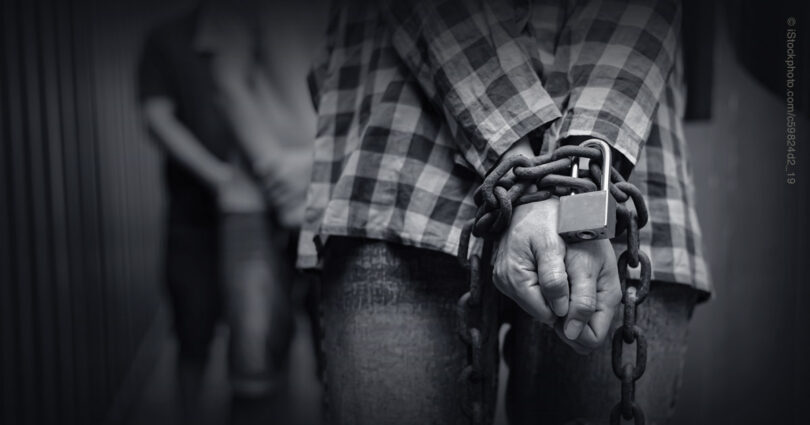
Pro-life values demand that we protect all human beings from the moment of creation until death. That protection includes preborn babies, those who are sick or disabled, and the elderly. But we also have a responsibility to protect those who have been taken from their homes and sold into human sex trafficking, which treats people like commodities while it abuses and enslaves them.
St. John Paul II once taught, “The trade in human persons constitutes a shocking offence against human dignity and a grave violation of fundamental human rights. . . . Such situations are an affront to fundamental values which are shared by all cultures and peoples.”1
The atrocity of human trafficking has come to light more frequently in the last several years, but many still do not understand how prolific it has become. The 2023 movie Sound of Freedom attempted to change that, as it brought multitudes of people face-to-face with the evil of sex trafficking. In the movie, which is based on the real-life experiences of child advocate Tim Ballard, two young siblings are taken from their father and sold. Viewers see firsthand the horrifying realities of trafficking.2
Yet, too many people are still unaware of its extent, especially here in the United States.
The lucrative industry of human trafficking
The United Nation’s International Labour Organization estimates that global human trafficking garners $236 billion per year.3 Of that estimate, 73%, or $173 billion, is produced by sex trafficking. In her article “Abortion and Sex-Trafficking Are Undeniably Linked Abuses against Women,” Patrina Mosley wrote, “A study by the Urban Institute that interviewed pimps and traffickers found they can make anywhere from $5,000 to $32,833 a week. Women and girls make up 71% of their victims.”4
Since the estimated price of a modern-day slave is $450,5 it’s no wonder more criminal organizations are turning to selling people instead of drugs.6
According to the ILO, among the estimated 27.6 million people who are trafficked worldwide, some 6.3 million are trafficked for sex. The United States ranks among the countries that have the lowest prevalence of slavery, but it has the highest estimated number of modern slaves in the Americas.7 According to the 2023 Global Slavery Index, more than 20% of people in slavery in that region are located in the US.8 Another 2023 study found that an estimated 1,091,000 people live in modern-day slavery in the US, a 173% increase from the estimated 400,000 people in slavery in 2017.9
California, Texas, and Florida are the top three states in the US for human trafficking cases, accounting for 25% of the national total.10 There are approximately 79,000 young adults, teenagers, and preteens who are sexually trafficked in Texas alone.11
While anyone can be taken and sold, traffickers most often prey on the young and the vulnerable—those lacking someone to care for and protect them.12
Lurking danger
Populations vulnerable to human trafficking may include those living in poverty, children in the welfare system, runaways, the homeless, or even children in a two-parent home if they feel neglected in some way. Women, minorities, people with disabilities, migrants, refugees, and those with language barriers are also targeted.
Additionally, people can be lured in by many different types of predators, including those who offer a false promise of a relationship, those with a fake job offer, or even someone exploiting a person who has an addiction.13 In many instances, we see that children are sold by immediate or extended family members so they can support themselves financially or buy alcohol or illegal drugs.14
Traffickers target places where young people often congregate or spend time, including on social media, on video gaming sites, in parks, and in bus stations and shopping malls. Vulnerable adults can also be tricked into believing a trafficker’s false story that promises a great job opportunity.15
While the average age that both girls and boys are first trafficked is 12, boys are now the fastest-growing group of victims.16 The US Department of State published an article entitled “Overlooked for Too Long: Boys and Human Trafficking,” which stated that “the percentage of boys identified as victims of human trafficking more than quintupled between 2004 and 2020.”17
Because boys are overlooked, they are also underserved. In 2019, there were only 2,143 beds available for sex-trafficked victims in nationwide shelters. Of these, less than 1% were for boys.18
If we desire to help all victims, we must look for the signs wherever we go and remember that sex trafficking doesn’t always fit the stereotypes.
The hellish reality of sex trafficking
Sadly, many aspects of sex trafficking do fit the stereotypes, especially those concerning the horrific abuses victims suffer. These horrors include isolation, malnutrition due to the withholding of food, broken bones and skull fractures from severe beatings, cigarette burn torture, forced drug use, and more, all of which are intended to keep each victim submissive and compliant.19 These abuses create physical, emotional, psychological, and spiritual health crises that can continue for a lifetime, even after the survivor has escaped or been rescued.
Sex trafficking victims are also forced into brutal, repeated sexual violations. A paper entitled “The Health Consequences of Sex Trafficking and Their Implications for Identifying Victims in Healthcare Facilities” examined 107 domestic survivors of sex trafficking who ranged in age from 14 to 60.20 It found that, on average, survivors were raped by about 13 buyers a day, though some reported that a “typical day” included 30 to 50 rapes. This sexual abuse often left victims with severe health issues, including sexually transmitted diseases, scarring, infections, and infertility.
Additionally, many women who became pregnant while trafficked were often forced to abort their babies. The study revealed that “more than half (55.2%) of the sixty-seven respondents who answered reported at least one abortion, with twenty respondents (29.9%) reporting multiple abortions.” One survivor endured 17 abortions while trafficked and said at least some were forced on her by her trafficker.
The study also found that “the prevalence of forced abortions is an especially disturbing trend in sex trafficking” and that Planned Parenthood was often involved. Nearly 30% of surveyed survivors had visited a Planned Parenthood facility while trafficked. As one survivor said, “At least one of my abortions was from Planned Parenthood because they didn’t ask any questions.”
While devastating, this finding is not surprising. The pro-life movement has long known that the abortion industry works hand-in-hand with sex traffickers. In 2011, Live Action’s Aiding Abusers investigation showed how Planned Parenthood ignored signs of trafficking among minor patients.21 Abortion workers even coached the undercover “pimps” on how to procure abortions for their underage victims without alerting authorities.
In an article entitled “Human Trafficking: The Hidden Assault on Human Dignity,” Fr. Shenan J. Boquet, president of Human Life International, wrote:
“Human trafficking is indirectly linked to the pro-life and pro-family cause insofar as all assaults on human life and dignity are interrelated and mutually supportive. However, it is also directly linked to the pro-life cause, insofar as human traffickers, especially sex traffickers, routinely force their victims to take abortifacient contraception or to undergo surgical abortions when they get pregnant. The abortion industry, alas, is only too willing to help out.”22
When the “pro-woman” abortion industry exploits and harms victims of sex trafficking, as it always does, pro-lifers must be ready to offer help, healing, and hope.
Take action
As those who fight for the lives and dignity of all people, pro-lifers oppose sex trafficking not only for the sake of the preborn babies killed in forced abortions but for the children, women, and men it violates every day.
The Catechism of the Catholic Church teaches that “the dignity of the human person is rooted in his creation in the image and likeness of God . . . [and] fulfilled in his vocation to divine beatitude.”23
It is incumbent on us to fight for and uphold the dignity of all human beings. That requires action. Many people have asked, “How can I help?” Below are 10 ways that you can make a difference in your community and educate others about the dangers of human trafficking:
- Pray for direction.
- Contact your bishop or parish priest and ask him to address the subject in homilies.
- Create announcements for your bulletin to spread awareness about how victims can find help.
- To learn how you can help spread awareness, contact one or more of the following: Talitha Kum, an international program of religious sisters; the US Catholic Sisters Against Human Trafficking; Knights of Peter Claver; Catholic Daughters and Catholic Women; local Knights of Columbus; or the superintendent of your local Catholic schools.
- Ask cloistered communities and parish prayer groups to pray for the victims and for the success of your educational outreach.
- Talk to parish youth groups about online dangers or publish articles in diocesan papers.
- Work with a group to contact Catholic radio stations and ask them to broadcast public service announcements about trafficking and how victims can seek help.
- Work with your local, state, and federal officials to enact tougher laws for convicted traffickers and non-criminalization for victims.
- Contact local police and health personnel to ask if they have been trained and educated about trafficking. In a national survivor survey entitled “In Harm’s Way: How Systems Fail Human Trafficking Survivors,” researchers found that 62% of 457 survivor participants had either been cited, detained, or arrested at least once, while 81% stated that the arrests occurred while they were trafficked.24 The Health Consequences survey learned that 88% of victims saw a health professional while being trafficked.25 With proper training, people in these professions have a unique opportunity to reach and rescue those in modern slavery.
- Order free posters to display in public restrooms so victims can get the help they need. The Department of Homeland Security’s Blue Campaign offers free posters that you can download and display in fast-food, hotel, hospital, or gas-station restrooms. Include the national hotline number: 888-373-7888. If possible, include humantraffickingsearch.org.
- John Paul II, Letter to Archbishop Jean-Louis Tauran on the Occasion of the International Conference on the Theme: “Twenty-First Century Slavery – the Human Rights Dimension to Trafficking in Human Beings,” May 14, 2002, vatican.va/content/john-paul-ii/en/letters/2002/documents/hf_jp-ii_let_20020515_tauran.html.
- Alejandro Monteverde, director, The Sound of Freedom, Angel Studios, 2023, 2 hr., 11 min., angel.com/movies/sound-of-freedom.
- Francesca Francavilla, et al., Profits and Poverty: The Economics of Forced Labour, second edition, Geneva: International Labour Organization, 2024, ilo.org/sites/default/files/wcmsp5/groups/public/@ed_norm/@ipec/documents/publication/wcms_918034.pdf.
- Patrina Mosley, “Abortion and Sex-Trafficking Are Undeniably Linked Abuses Against Women,” The Federalist, January 31, 2020, thefederalist.com/2020/01/31/abortion-and-sex-trafficking-are-undeniably-linked-abuses-against-women.
- Kate Hodal, “One in 200 People Is a Slave. Why?” The Guardian, October 19, 2022, theguardian.com/news/2019/feb/25/modern-slavery-trafficking-persons-one-in-200.
- Rebecca Blackwell, “First Drugs, Then Oil, Now Mexican Cartels Turn to Human Trafficking,” NBC News, April 29, 2020, nbcnews.com/news/latino/first-drugs-then-oil-now-mexican-cartels-turn-human-trafficking-n1195551.
- Walk Free, The Global Slavery Index 2023, Perth: Minderoo Foundation, 2023, cdn.walkfree.org/content/uploads/2023/05/17114737/Global-Slavery-Index-2023.pdf.
- “Modern Slavery in United States,” Walk Free, August 22, 2023, walkfree.org/global-slavery-index/country-studies/united-states.
- Adam Hewitt, “More Than 1 Million Human Trafficking Victims in USA,” Hope for Justice, June 7, 2023, hopeforjustice.org/news/more-than-1-million-human-trafficking-victims-in-usa-new-study.
- “National Statistics,” National Human Trafficking Hotline, April 22, 2024, humantraffickinghotline.org/en/statistics.
- Noël Busch-Armendariz, et al., Human Trafficking by the Numbers: The Initial Benchmark of Prevalence and Economic Impact for Texas, Austin: Institute on Domestic Violence & Sexual Assault, The University of Texas at Austin, December 2016, sites.utexas.edu/idvsa/files/2019/03/Human-Trafficking-by-the-Numbers-2016.pdf.
- “Vulnerabilities & Recruitment,” The Polaris Project, January 16, 2024, polarisproject.org/vulnerabilities-and-recruitment.
- “Sex Trafficking Examples,” The Polaris Project, March 24, 2022, polarisproject.org/vulnerabilities-and-recruitment.
- “Navigating the Unique Complexities in Familial Trafficking,” United States Department of State, May 5, 2025, state.gov/navigating-the-unique-complexities-in-familial-trafficking.
- “Love and Trafficking: How Traffickers Groom & Control Their Victims,” The Polaris Project (blog), December 20, 2021, polarisproject.org/blog/2021/02/love-and-trafficking-how-traffickers-groom-control-their-victims.
- “Human Trafficking Fact Sheet,” Washington, DC: Office of the Attorney General for the District of Columbia, 2020, oag.dc.gov/public-safety/human-trafficking-initiatives/human-trafficking-fact-sheet.
- Office to Monitor and Combat Trafficking in Persons, Trafficking in Persons Report June 2023, Washington, DC: US Department of State, June 2023, state.gov/wp-content/uploads/2023/05/Trafficking-in-Persons-Report-2023_Introduction-Additional-Pagesv4_FINAL.pdf.
- Beth Cormack, “Finding Shelter: Taking Care of Human Trafficking Survivors,” Saint Francis Ministries, September 16, 2024, saintfrancisministries.org/human-trafficking.
- Dominique Roe-Sepowitz, et al., What You Need to Know: Sex Trafficking and Sexual Exploitation, a Training Tool for EMS Providers, Tempe: Arizona State University School of Social Work, April 1, 2015, lacounty.gov/wp-content/uploads/2022/02/ASU-EMS-Brochure.pdf.
- Laura J. Lederer, et al., “The Health Consequences of Sex Trafficking and Their Implications for Identifying Victims in Healthcare Facilities,” Annals of Health Law 23, no. 1 (October 2015), icmec.org/wp-content/uploads/2015/10/Health-Consequences-of-Sex-Trafficking-and-Implications-for-Identifying-Victims-Lederer.pdf.
- Cassy Cooke, “‘They Didn’t Ask Questions’: A Look Back at How Planned Parenthood Exploits Victims of Sex Trafficking,” Live Action News, May 6, 2021, liveaction.org/news/questions-planned-parenthood-exploits-victims-sex-trafficking.
- Shenan J. Boquet, “Human Trafficking: The Hidden Assault on Human Dignity,” Human Life International, May 1, 2023, hli.org/2018/01/human-trafficking-the-hidden-assault-on-human-dignity.
- Catechism of the Catholic Church, Second Edition, Online Version, 1993, vatican.va/archive/eng0015/_index.htm.
- In Harm’s Way: How Systems Fail Human Trafficking Survivors, Washington, DC: The Polaris Project, January 2023, polarisproject.org/wp-content/uploads/2023/07/In-Harms-Way-How-Systems-Fail-Human-Trafficking-Survivors-by-Polaris-modifed-June-2023.pdf.
- Laura J. Lederer, et al., “The Health Consequences of Sex Trafficking and Their Implications for Identifying Victims in Healthcare Facilities,” Annals of Health Law 23, no. 1 (October 2015), icmec.org/wp-content/uploads/2015/10/Health-Consequences-of-Sex-Trafficking-and-Implications-for-Identifying-Victims-Lederer.pdf.

Facebook Comments